Every year, organizations invest significant time, money, and energy in Performance Management Systems. Yet many initiatives quietly fail—not because the software was poor or the methodology was wrong, but because the organization chose a system that didn’t fit its business.
The consequences are costly. Goals become unclear. Managers stop reviewing progress. Employees lose confidence. Eventually, the system becomes another spreadsheet exercise instead of a driver of business performance.
The encouraging news is that choosing the right approach doesn’t have to be complicated.
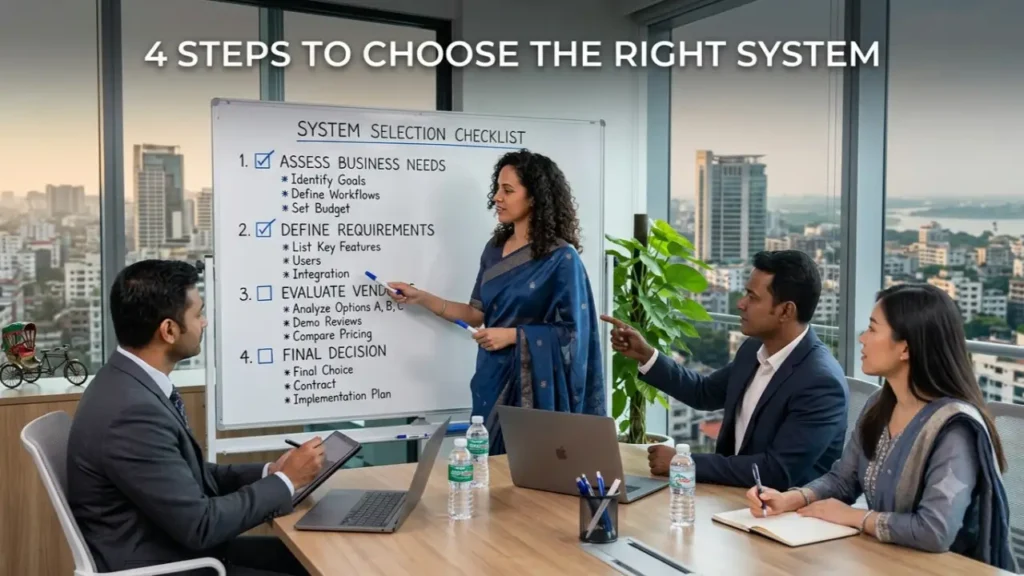
After helping organizations across Bangladesh implement Strategy Execution and Performance Management Systems, I’ve found that successful organizations ask four simple questions before selecting a framework.
Don’t choose what’s fashionable. Choose what fits your organization.
Step 1: Understand Where Your Organization Is Today
Every organization is at a different stage of its journey.
A startup trying to grow quickly has very different needs from a mature manufacturing company or a traditional family-owned business.
Choose the framework that matches your current reality.
- Startup or high-growth company → OKRs to drive innovation, agility, and ambitious goals.
- Established organization → Balanced Scorecard to balance financial results with customers, internal processes, and people development.
- Traditional management culture → Management by Objectives (MBO) to create clear accountability and direction.
- Operations-driven business → KPIs to monitor performance, efficiency, and operational excellence.
One size never fits every organization.
The best-performing companies don’t copy others—they choose what fits their own strategy and culture.
Step 2: Identify Your Most Important Business Priority
Before discussing software or methodology, answer one simple question:
What must your organization achieve over the next 12 months?
Your answer should determine your framework.
If your priority is…
- Faster innovation and adaptability → OKRs
- Strategic alignment across the organization → Balanced Scorecard
- Individual ownership and accountability → MBO
- Operational efficiency and measurable results → KPIs
- Better employee engagement and goal clarity → SMART Goals
A performance management system should solve your biggest business challenge—not create a new one.
Step 3: Be Honest About Your Capability to Sustain It
This is where many organizations struggle.
Performance management isn’t a one-time workshop or an annual appraisal exercise.
It requires continuous goal updates, regular reviews, coaching conversations, and leadership commitment throughout the year.
Without the right processes and technology, enthusiasm fades quickly.
Goals stay in spreadsheets.
Managers postpone reviews.
Employees stop updating progress.
Eventually, the system becomes another administrative burden.
The lesson is simple:
Step 4: Start Small Before Scaling Organization-Wide
Many organizations make the mistake of launching a new performance management system across every department on day one.
That increases risk.
Instead, start with one department or business unit.
Run a structured pilot for around three months.
Measure adoption.
Collect feedback.
Refine the process.
Once leaders and employees gain confidence, expand across the organization.
Small pilots often prevent large failures.
A Quick Reality Check Before You Decide
Before choosing any Performance Management System, ask yourself:
- Does this framework support our business strategy?
- Will our employees understand it?
- Can managers monitor progress consistently?
- Do we have reliable data and leadership commitment?
- Can goals be cascaded from the corporate level to every employee?
- Will this improve performance—or simply create more administration?
If you answer “No” to two or more questions, pause before making your investment.
Choosing the wrong system doesn’t simply waste money.
It can cost an entire year of strategy execution.
Coming Next
In my next article, I’ll walk through four real business scenarios—from manufacturing and fintech to consulting—and show exactly which framework I would recommend in each situation, and why.
Because selecting the right methodology is only half the journey.
Implementing it successfully is where organizations create a real competitive advantage. #PeopleKPIs #PeopleScore #PeopleOKRs #PeopleMBO #PeopleGoals #Savvygx #PerformanceManagement #StrategyExecution #GoalManagement #BusinessPerformance