Your ERP Isn’t Built for Performance Management. Here’s the Cost of Getting It Wrong.
Imagine this.
It’s appraisal season.
A manager opens the ERP dashboard, looks at last quarter’s sales numbers, production reports, or customer complaints, and starts rating employees.
The numbers are real. The reports are accurate.
But one important question remains…
Did those numbers really tell the whole story?
Most organizations unknowingly make one critical mistake: They use ERP to evaluate people.
The problem is that ERP was never designed for Performance Management.
And that’s where the trouble begins.
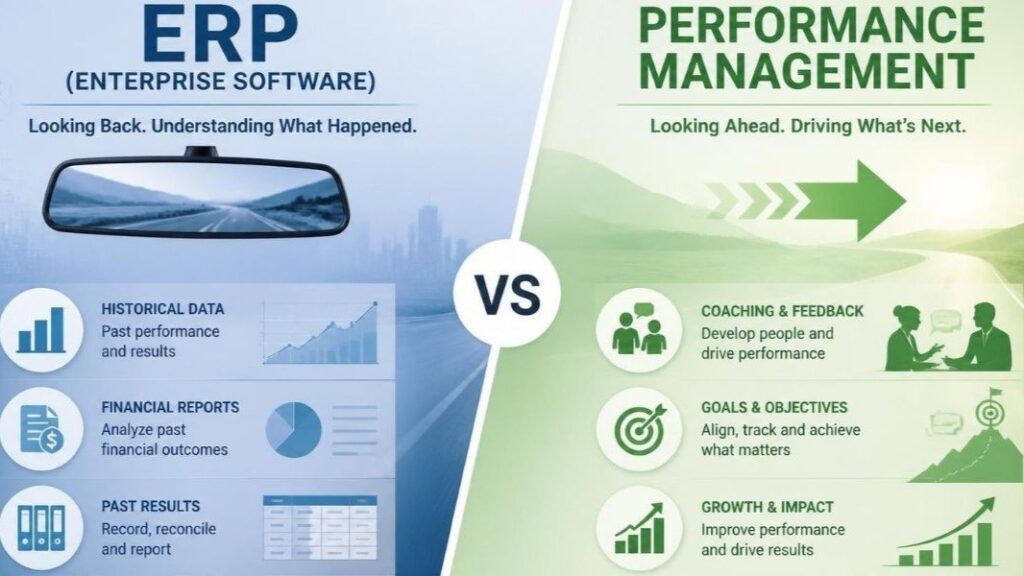
ERP Tells You What Happened
Think of an ERP as your organization’s accountant.
It records transactions. It stores invoices. It tracks inventory. It captures sales, purchases, shipments, collections, and financial results.
ERP is excellent at answering questions like:
- How much did we sell?
- How many products were manufactured?
- How much revenue did we earn?
- What was our production cost?
These are important business results.
But they all have one thing in common.
They are history.
They tell you what already happened, not why it happened.
Performance Management Looks Forward
A good Performance Management System asks very different questions.
Instead of asking…
“What happened?”
…it asks…
“What should we do next?”
Performance Management is about helping people improve before the final results arrive.
It focuses on:
- Goals
- KPIs
- Behaviours
- Coaching
- Continuous feedback
- Capability development
Because better actions today create better business results tomorrow.
The Biggest Mistake Companies Make
Many organizations pull ERP reports and call them KPIs.
For example:
A salesperson achieved Tk. 500,000 in sales last quarter.
ERP records that number perfectly.
But ERP doesn’t tell you:
- How many new prospects were contacted?
- How many customer meetings were held?
- Whether proposals were high quality.
- Whether strategic relationships were built.
- Whether the salesperson consistently followed up with customers.
Those activities are what actually create future sales.
If you only reward the final number, you’re measuring the destination not the journey that got you there.
And without understanding the journey, improvement becomes almost impossible.
Great Performance Systems Measure Both Results and Actions
High-performing organizations don’t rely only on lagging indicators (final results).
They also measure leading indicators the activities that drive those results.
Think of it this way:
Lagging KPIs tell you whether you won.
Leading KPIs tell you whether you’re likely to win.
That’s a huge difference.
A Simple 60:40 Rule
One practical guideline is:
- Less than 40% of your KPIs should come directly from ERP data (lagging indicators).
- More than 60% should measure leading indicators such as activities, quality, behaviours, collaboration, innovation, customer engagement, and continuous improvement.
ERP should provide evidence of the final score.
Performance Management should help people improve the scores.
Real Examples
Sales Executive
Lagging KPI
% Quarterly Revenue
Leading KPIs
# Discovery calls completed
# Strategic client meetings
% Proposal quality score
# On-time CRM updates
Factory Supervisor
Lagging KPI
% Product defect rate
Leading KPIs
# Preventive maintenance completed
# Safety inspections
% First-Time-Right checks
# Process improvement suggestions
FMCG Distributor
Lagging KPI
# Units sold
Leading KPIs
% Route plan compliance
# Outlet visits
% Shelf availability
# Trade promotion execution
Software Developer
Lagging KPI
# Production bugs
Leading KPIs
# Code reviews
% Test coverage
% Documentation quality
# Knowledge sharing
Customer Support
Lagging KPI
% Tickets resolved
Leading KPIs
% First response time
% Customer engagement
# Root-cause analysis
HR Professional
Lagging KPI
# Time-to-hire* (Based on perspectives)
Leading KPIs
% Candidate net promoter score
% Hiring manager satisfaction
Building a Better Performance Management System
A practical approach is surprisingly simple.
- Start with the goal. What should success look like 6-12 months from now?
- Identify the actions that will create that success. These become your leading KPIs.
- Connect ERP automatically. Use ERP to bring in financial and operational results without manual entry.
- Balance your scorecard. Combine leading and lagging indicators instead of relying on history alone.
- Coach continuously. Managers should spend less time discussing scores and more time removing obstacles, providing feedback, and helping employees succeed.
Even Without Sophisticated Software, You Can Start Today
Not every organization has an advanced Performance Management System and that’s okay.
Start small.
- Focus on just 4-6 meaningful KPIs per role.
- Use Excel, Google Sheets, or mobile forms to track leading indicators.
- Reward both results and the behaviours that create those results.
- Encourage managers to have short weekly coaching conversations instead of waiting for annual appraisals.
Small improvements, repeated consistently, produce remarkable performance over time.
The Bottom Line
ERP is an outstanding business system.
But it is not a Performance Management System.
ERP tells you:
“What happened?”
Performance Management asks:
“What should we do next to perform even better?”
If you want employees to improve, don’t measure only yesterday’s results.
Measure today’s actions that will create tomorrow’s success.
Because you can’t drive your organization forward by looking only in the rear-view mirror.
Note: I collaborated with AI throughout the process from brainstorming and research to initial drafting. I reviewed, edited, and stand behind every point. #PeopleKPIs #PeopleScore #PeopleOKRs #PeopleMBO #PeopleGoals #Savvygx #PerformanceManagement #StrategyExecution #GoalManagement #BusinessPerformance