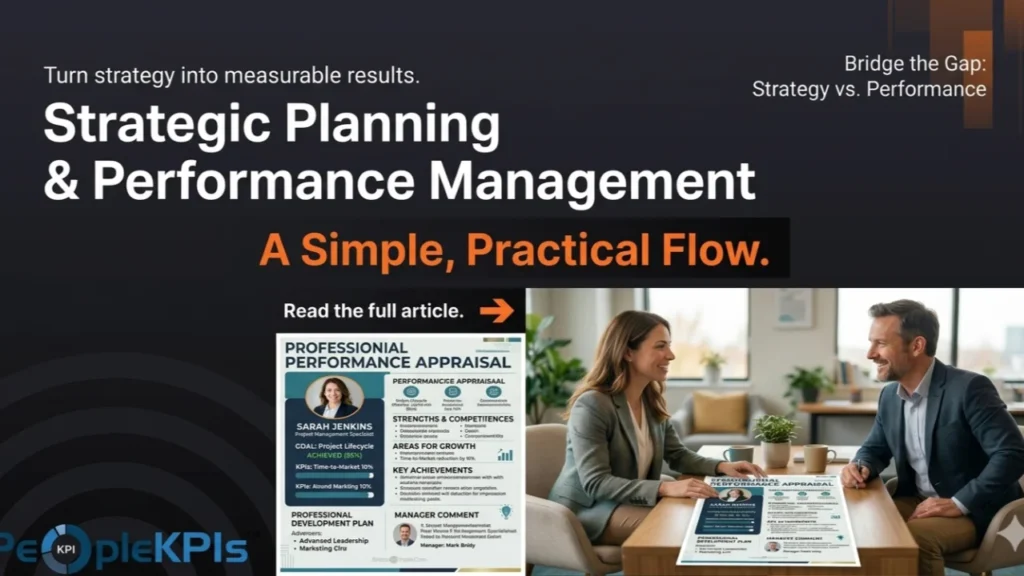
Every organisation succeeds when strategy and day-to-day work are tightly connected. Here’s a straightforward way to think about Strategic Planning and Performance Management — from executive vision to individual appraisal — so teams move together and deliver results.
- Executive and HOD Alignment: Set direction together
- Executive Leaders and all Heads of Department (HODs) jointly articulate the organisation’s vision, mission, strategic goals, and top priorities.
- This consensus creates clarity and ownership at the leadership level, so the strategy reflects operational realities.
2. Departmental Operational Planning
- HODs, together with their teams, translate corporate strategy into department-level operational plans.
- These plans define key initiatives, resources, timelines, and who’s accountable for what.
3. Individual Goal-setting, KPI Alignment & Cascading
- Each employee sets individual goals and KPIs that directly align with their function’s operational plan and the corporate goals.
- Goals follow SMART principles (specific, measurable, achievable, relevant, time-bound) so expectations are clear.
4. Routine Performance Tracking
- At agreed frequencies (monthly, quarterly), KPI results are uploaded into the performance system.
- This creates a live performance view: progress updates, flags for intervention, and data for decisions.
5. Qualitative assessment
- Qualitative elements (behaviours & competencies) are assessed through self-evaluation, supervisor review, and HOD validation.
- Multiple perspectives improve fairness and provide richer feedback.
6. End-of-Period Appraisal and Development Planning
- At the end of the performance period, a formal appraisal session reviews results and qualitative feedback.
- The conversation focuses on strengths, improvement areas, and next steps — not just a score.
7. Follow-up: IDP and PIP where needed
- Development needs feed into an Individual Development Plan (IDP) for growth and career progression.
- If performance gaps are significant, a Performance Improvement Plan (PIP) sets clear actions, support, and timelines.
8. Reporting and Transparency
- Performance reports are produced regularly — think of them like a monthly payslip for performance: clear, standardized, and easy to understand.
- These reports help leaders and employees see alignment from strategy to individual contributions.
Why does this matter?
Alignment: Strategy becomes operational through cascading goals — everyone knows how they contribute.
Accountability: Regular KPI updates and qualitative reviews keep performance visible and actionable.
Development-focused: Appraisals drive learning (IDPs) and corrective support (PIPs), not just ratings.
Simplicity: A single, repeatable flow makes the system scalable and trusted across the organization.
Final thought
This is essentially a cascading alignment system — from vision to tasks, from KPIs to appraisal, and from feedback to development. When leaders and teams follow this clear, participative flow, strategy stops being a document and becomes daily performance.
“We simplify strategy execution & Performance Management”
#PeopleKPIs™ #PeopleScore™ #PeoleOKRs™ #PeopleMBO™ #PeopleGoals™